





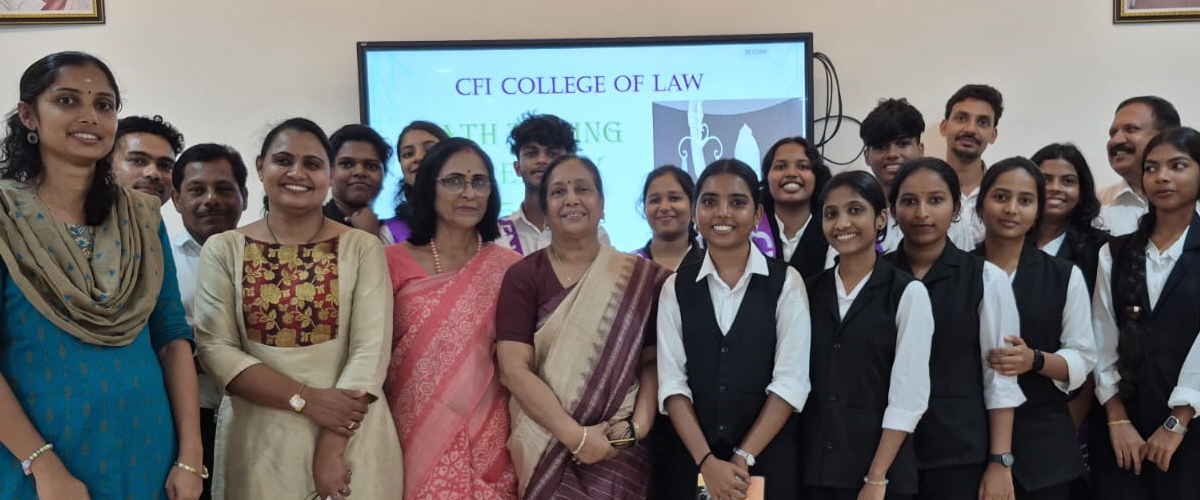

Learn from seasoned legal professionals dedicated to shaping your success.

Simulate real courtroom experiences with cutting-edge facilities.

Hands-on legal practice through community service and real client interaction.

Gain practical insights through internships, workshops, and expert interactions.

Established under CFI to serve underserved communities through legal education

To educate future lawyers to uphold justice, equality, and democratic values

To be a center of excellence in legal education with global competencies and ethical foundations
Driving Development Through Robust Infrastructure

Simulated courtrooms to practice arguments and case studies

Extensive legal texts, journals, AIR, SCC & Manupatra access

Audio-visual smartboards and e-learning tools

Real-time experience in public legal services

Legal software training and online legal databases

Safe, hygienic, and inclusive campus amenities

5-Year Integrated B.com, L.L.B. (Honours.)
5-Year B.B.A., L.L.B. (Honours.)

AI accountability focuses on who is legally and ethically responsible when artificial intelligence systems cause harm. As AI increasingly influences decisions affecting rights, privacy, and equality, strong legal frameworks are essential. Understanding AI accountability prepares future lawyers to regulate technology, protect society, and uphold justice in the digital age.
Read More
The Tata Sons vs Cyrus Mistry case highlights the importance of fiduciary duties, board accountability, and corporate governance in India. It underscores that directors must act responsibly—values deeply emphasized at CFI College of Law, where ethics and corporate law education go hand in hand.
Read More
The Prem Shankar Shukla vs. Delhi Administration (1980) case established that routine handcuffing violates Article 21 of the Indian Constitution. The Supreme Court emphasized human dignity, judicial oversight, and constitutional accountability, making this judgment a cornerstone of Indian criminal and constitutional law education.
Read More
The blog highlights key differences between BBA LLB and B.Com LLB. While BBA LLB blends business and law for corporate careers, B.Com LLB integrates commerce and law for finance or taxation roles. Both are five-year programs preparing students for diverse legal and professional opportunities.
Read More
The Tamilaga Vettri Kazhagam v. P.H. Dinesh case underscores the significance of judicial oversight and public safety in India. The Supreme Court’s intervention ensures impartial investigation and accountability, offering law students critical insights into constitutional law, political responsibility, and legal analysis.
Read More
In State of Punjab v. Davinder Singh (2024), the Supreme Court ruled that states can sub-categorize Scheduled Castes for equitable reservation benefits. The judgment emphasizes substantive equality, ensures the most disadvantaged groups receive representation, and sets a landmark precedent in constitutional law, social justice, and reservation policy.
Read More